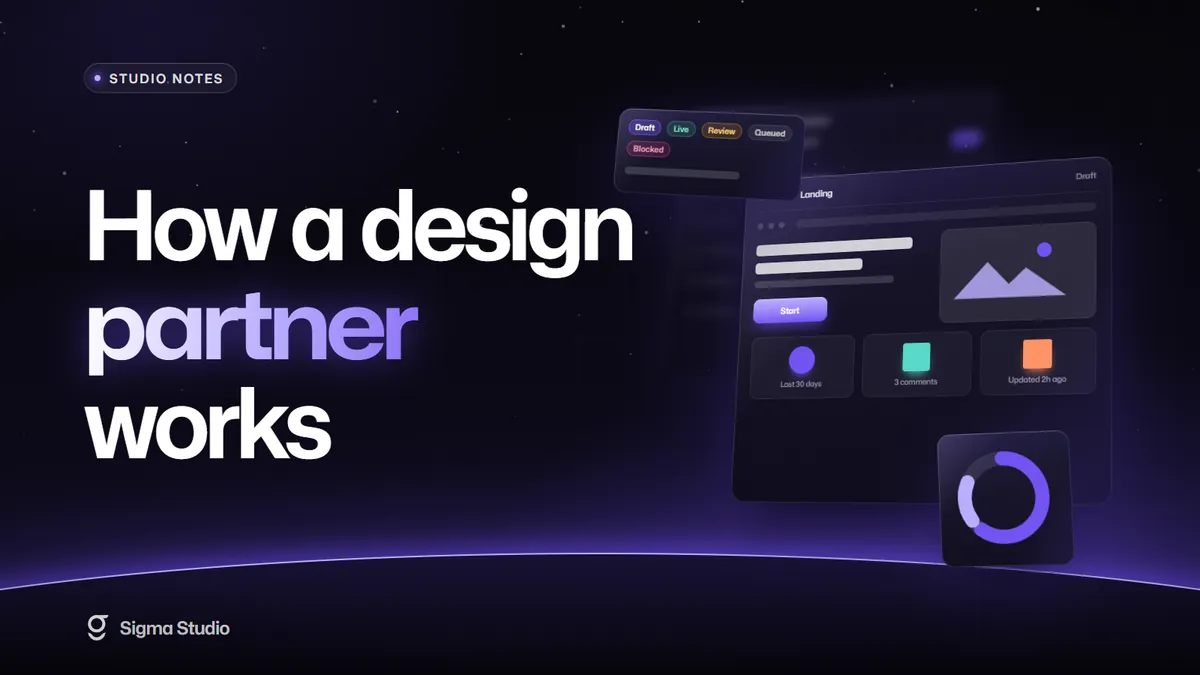
What a design partner is
Launching a product is not the end of the design work. New features come, the pricing page changes, onboarding needs a fix, and an investor wants a demo next week. You need design help every week, but you may not be ready to hire a full-time designer.
That is the gap a monthly design plan fills. We call ours Design Partner. For $3,200 a month, a senior product designer works on your product. You send requests, we do them, and you pay month by month. Some people call this a design subscription. We prefer "partner", because the point is that the same person learns your product over time and gets better at helping you.
It is not a pile of hours and it is not a ticket system run by strangers. It is one senior person who knows your product, working in your Slack, on your priorities.
How requests work
The flow is simple, and the simplicity is on purpose.
- Kickoff. We learn your product, your team and your tools. We agree how requests are sent and who approves them.
- You post a request in Slack. Describe the goal, add links or screenshots, and say what done looks like. A few lines can be enough.
- We confirm it and start. If something is unclear, we ask before we begin, not halfway.
- We return the work in Figma, with a short note on the decisions behind it.
- You review and comment. We refine until it is right.
A request can be almost any design task: a new screen, a fix to a flow, a pricing page, a prototype, an update to the design system. Larger tasks are split into steps, so you see progress along the way and can change direction early.
A clear request gets a better first draft. Say what you want to happen, who it is for, and any limits, such as an engineering constraint or a deadline.
Turnaround and priorities
We work on one active request at a time. It sounds like a limit, and it is. But it is the reason the work is good. A senior designer who focuses on one thing finishes it better than one who juggles five.
Most requests come back in about 48 hours. Bigger tasks take longer, and we tell you when we start how we plan to approach them.
You control the order. If you have three requests waiting, you choose which one goes first. If something urgent comes up, you can change the priority. We do not decide what matters in your business. You do.
This also helps you think. When only one request moves at a time, the queue pushes you to decide what really matters most this week. Many teams find that useful on its own.
Weekly Loom updates
Every week we send a short Loom video. It shows what we finished, what is next, and anything we need from you. You can watch it in a few minutes, when it suits you, and reply with comments.
The update replaces a standing meeting. It also gives anyone on your team, including a cofounder or an investor, a quick look at what design is doing, without having to ask. You can change priorities at any point, in Slack or in reply to the video.
We still hold calls when a call is the better tool, such as for a complex decision or a design review with your engineers. We just do not schedule them by default.
Adding a front-end engineer
Some teams need more than designs. They need production UI built, and they do not have front-end capacity. For those teams, we can add a front-end engineer to the plan.
The designer and the engineer work together. They ship real UI in React, Next.js or Framer, so what you see in Figma and what your users see in the product stay in step. This avoids the usual loss between a design file and shipped code. The price of this option is higher, and the current figure is on our pricing page.
If your own developers prefer to build, you do not need this. We hand over clear components and states, and they work from those.
When it is a poor fit
We would rather tell you now than after you pay. A design partner plan is not a good match when:
- You have one clear project with an end. A new MVP, a website, a rebrand. A fixed-scope project, such as an MVP design sprint, is a better fit and often a better price.
- You need several things done at the same time, every day. One request at a time will frustrate you. A larger team or an in-house hire suits you better.
- You need someone in your office, in your time zone, all day, in every meeting.
- There is little design work. If you only need a few screens a quarter, a project will be cheaper than a month-by-month plan.
- Nobody on your side can set priorities. Requests need an owner who can say what matters and approve the result.
- You want research at scale. The plan is built around design work, not large user studies.
It fits best when your product keeps changing, design needs are steady, and you want a senior person with context, without a full-time salary.
Pausing and cancelling
You pay month by month, and you can pause or cancel at any time. We do not lock you into a long contract. Our view is that if the work is useful, you will keep it. If it is not, you should be free to stop.
Pausing is useful when your roadmap has a quiet stretch, or when you are waiting on engineering. If you pause, tell us, and we will agree how to pick things up again when you return.
When the plan ends, the Figma files are yours. Your team can carry on from them.
How it compares with other options
If you are weighing a design partner against a freelancer, an agency project or a hire, the short version is this. A freelancer is flexible but depends on one person's time. A project is best for a defined job. A hire is best for steady, high-volume work. A design partner sits between: steady help, senior experience, and a month-to-month commitment.
You can read the full details on the Design Partner page. If you are not sure it fits, tell us about your product and how much design work you expect through the contact page. We will say honestly whether a monthly plan, a project or something else makes more sense.